
Three experiments before terminology
Music theory for beginners: three playful sound experiments
You can hear a musical relationship before you know its name. Make the sound first; add words such as pitch, rhythm, rest, scale, and timbre only when they help explain what your ears already noticed.
Experiment 1: Pitch, direction, and contour
Pitch is the sense that a sound is higher or lower. On this canvas the idea is visible, so a beginner can hear contour before learning how melodies are written on a staff.
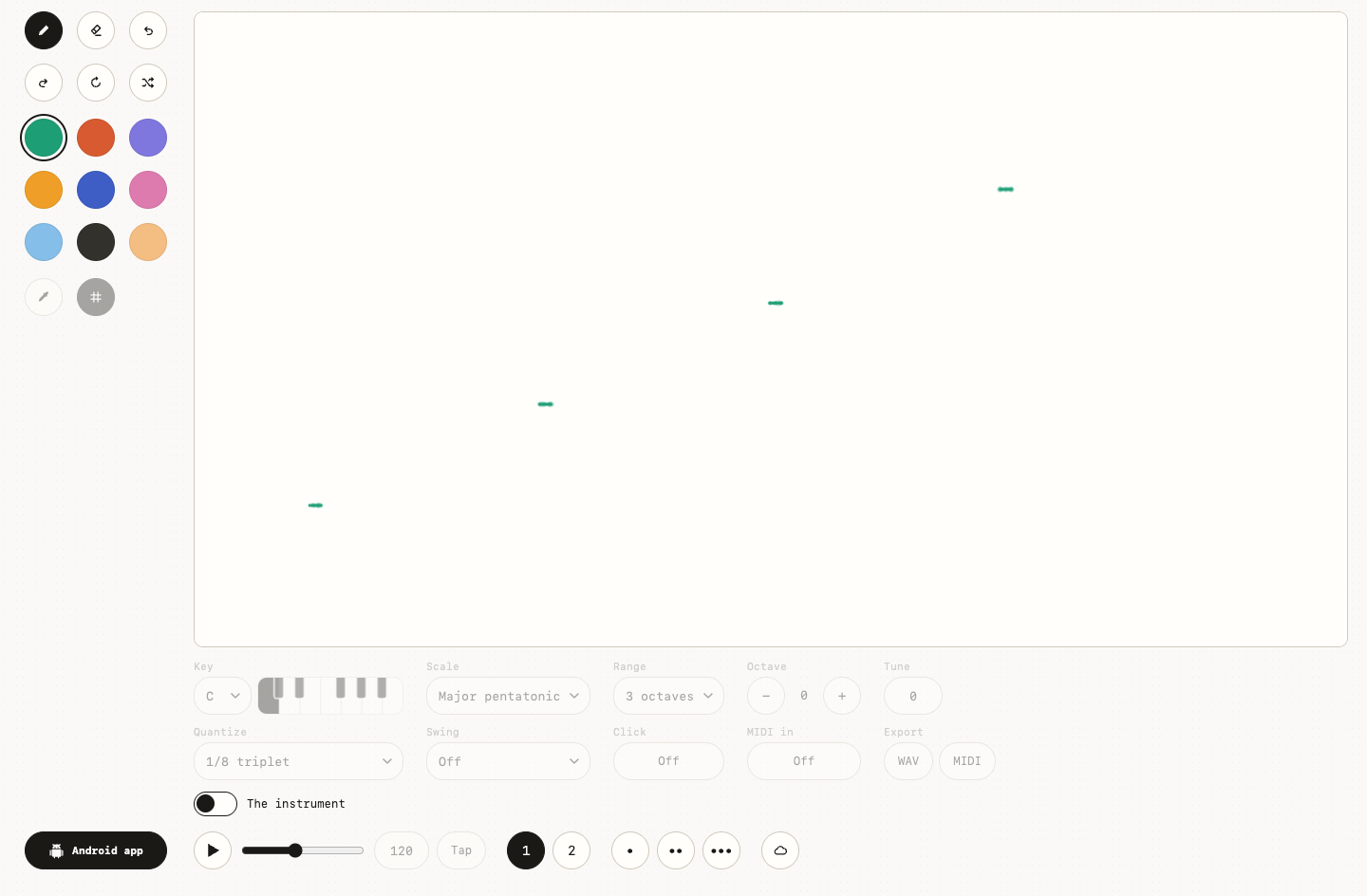
Try it once: Place a low dot, a middle dot, and a high dot from left to right. Lower the final dot beneath the middle one while keeping its time position.
Contour describes the overall direction of pitch movement, independent of the exact note names. Ask yourself: Does the three-note idea now rise and fall instead of continuing upward?
The easy mistake is worrying about naming every note before hearing the shape. If that happens, describe the direction first, then use the grid labels only if note names help your next decision.
If that works, take it one step further: Draw a smooth curve through the three regions and compare it with the separated dots. Both versions should share a contour while differing in continuity and articulation. Stop there for a moment. The small version is easier to hear than a crowded canvas.
- Start: Place a low dot, a middle dot, and a high dot from left to right.
- Change: Lower the final dot beneath the middle one while keeping its time position.
- Listen: Does the three-note idea now rise and fall instead of continuing upward?
Experiment 2: Rhythm needs events and silence
Rhythm is not a row of sounds alone. The timing and duration of the gaps shape expectation, make groups, and let a later event feel early, late, heavy, or light.
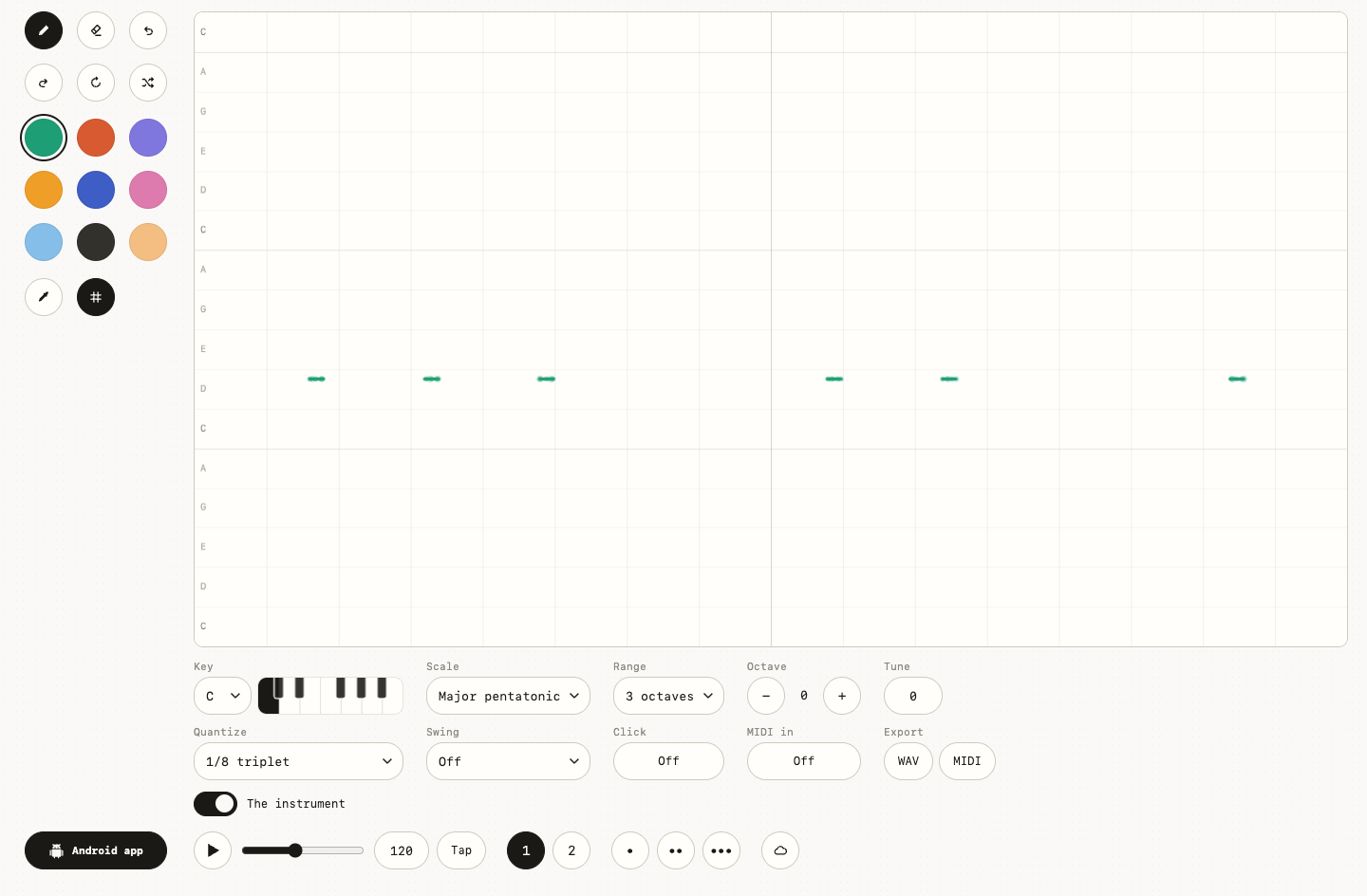
For the next pass: Make four evenly spaced marks, listen, and then erase the third mark. Move the fourth mark toward the empty third position.
A rest is organized silence whose position is understood in relation to surrounding events or a pulse. Ask yourself: When does the missing event feel like a rest, and when does the phrase simply sound shorter?
This gets muddy when you start assuming that turning on a beat automatically gives an unclear drawing a clear rhythm. If that happens, turn accompaniment off, rebuild the four-event reference, and hear the removed event against that memory.
A good second take is simple: Add the click after the drawn rhythm is clear and test whether the marks align or push against it. You should hear the difference between a rest inside a pattern and a loose gap without a stable reference. If the second take surprises you, keep it. A useful test can become a song idea.
Experiment 3: Key and scale shape the available pitch world
A scale is a selected collection of pitches, and a key establishes a tonal center. The editor lets the same visible gesture be heard through different collections without requiring notation first.
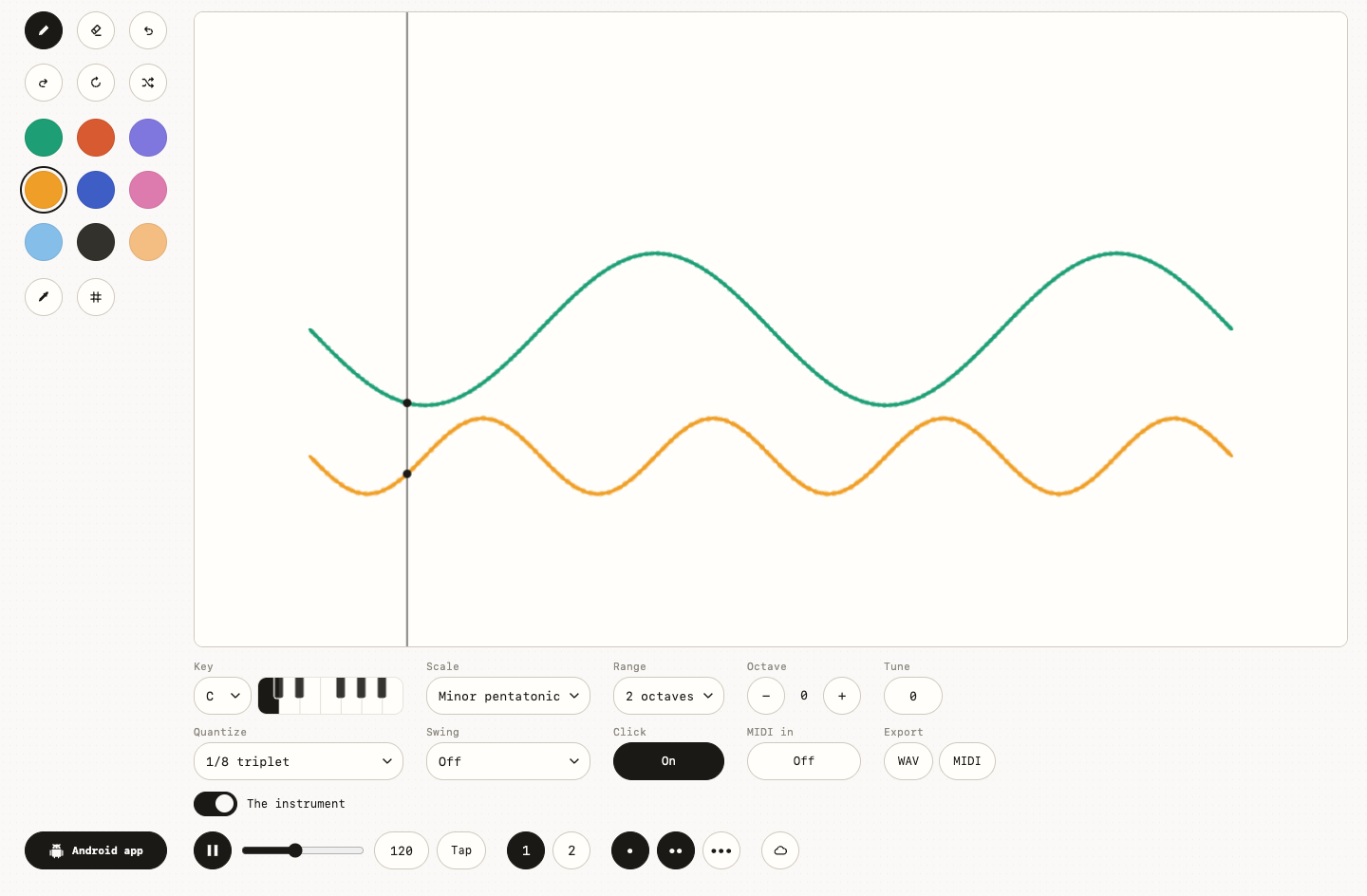
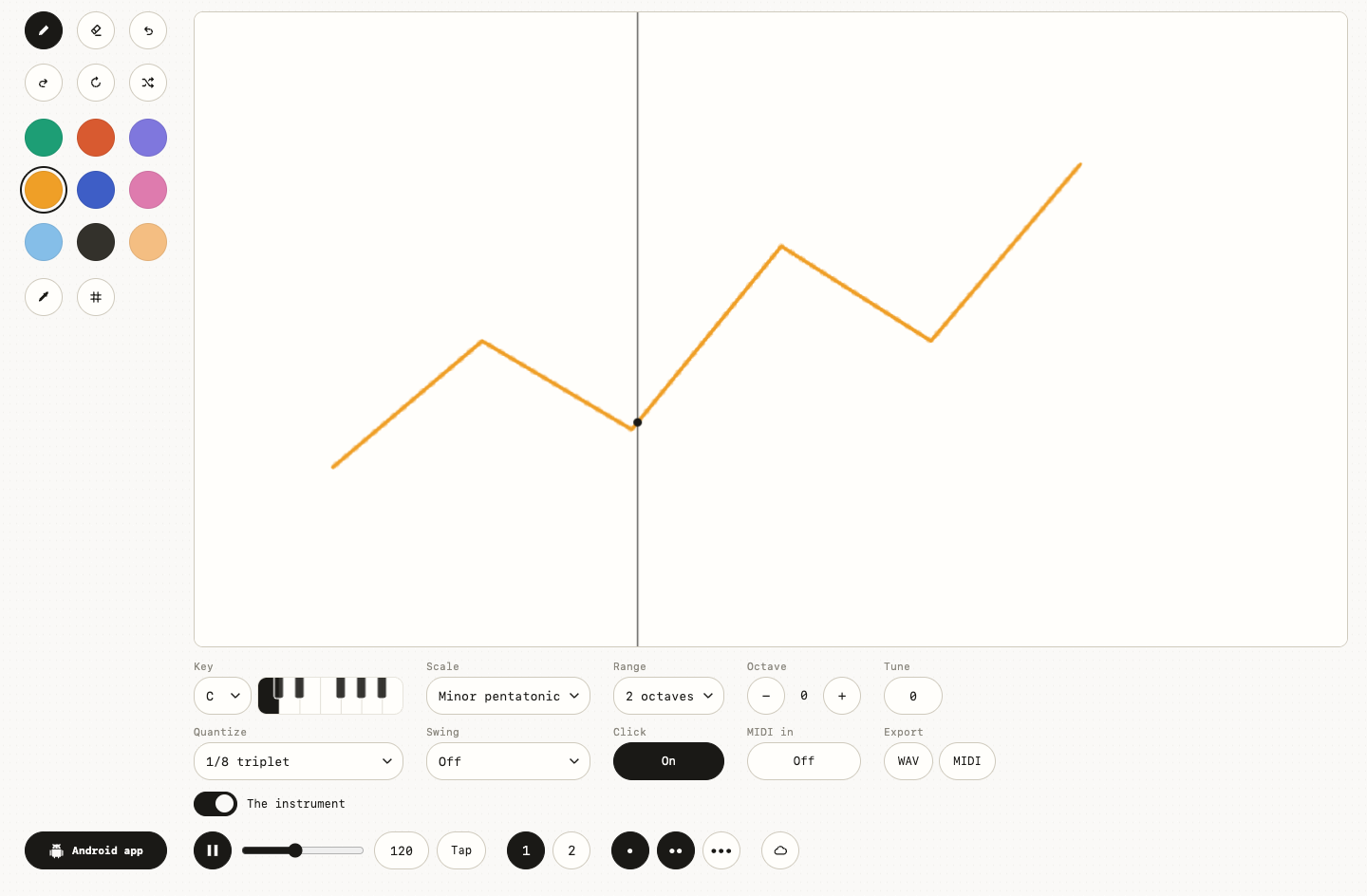
Start small: Draw one zigzag and listen in the default key and major pentatonic scale. Keep the drawing fixed while selecting minor pentatonic, then compare a new key.
Changing scale or key remaps vertical positions to a different organized set of pitches. Ask yourself: Which change alters the mood or pull of the phrase while its visual rhythm remains stable?
Watch out for calling one scale happy and another sad as if the label predicts every possible phrase. If that happens, describe concrete pitch behavior and personal impression without treating a stereotype as a rule.
If you are curious, try this: Try the same gesture in three scales and rank them for this drawing rather than in general. You should hear several valid interpretations of one contour, not a single correct answer. You may prefer the imperfect version. That is a choice, not a failed experiment.
Experiment 4: Range, octave, and interval size
Range determines how much pitch distance the height of the paper covers. Octave controls shift the register, allowing a familiar contour to sound broader, narrower, higher, or lower.
Here is the useful comparison: Draw two marks with a large vertical gap and listen with the current range. Select a narrower range, then restore it and shift the octave.
Range affects the span represented by the canvas; octave movement transposes the material into another register. Ask yourself: Which control changes the distance between the two pitches, and which moves them together?
If the result is hard to read, you may be changing range and octave simultaneously and confusing spread with register. If that happens, return both controls to the starting state and compare them in separate passes.
There is one more version worth hearing: Build a four-mark chord-like stack and test it across two ranges. The narrow setting should compress pitch distances while octave shifts preserve their relative shape. The point is not to win the comparison; it is to notice what changed.
Experiment 5: Timbre, texture, and layers
Timbre is the character of a sound, and texture describes how musical parts combine. The colored voices make both ideas available through a visual comparison.
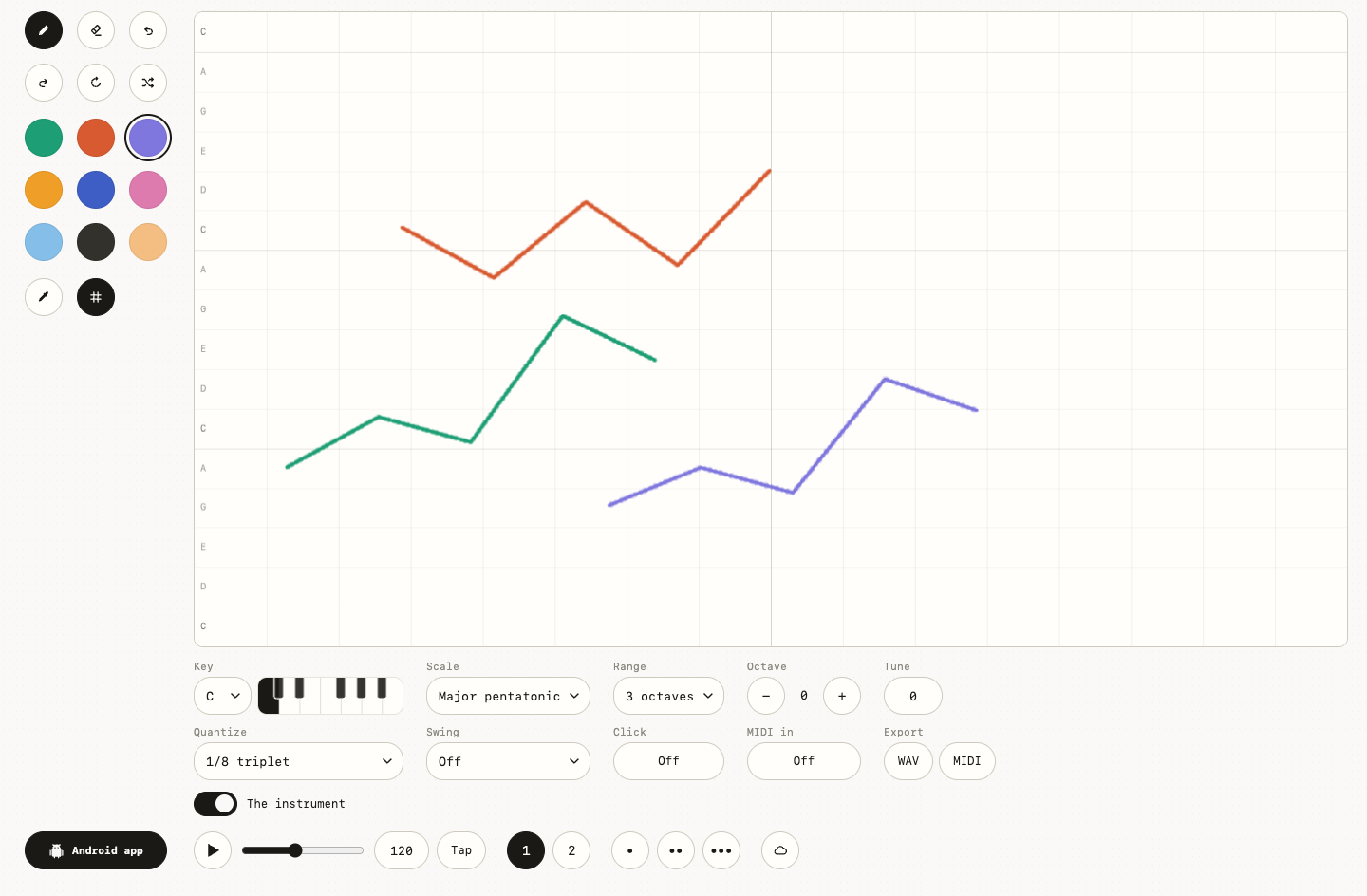
Before adding anything else: Repeat one contour in two colors, then place a third color underneath as a slow support line. Remove the support line and compare the thickness and focus of the result.
Multiple timbres can reinforce a moment or create independent roles, changing texture without rewriting every pitch. Ask yourself: Does the layered version feel richer, heavier, busier, or less clear?
The comparison stops being useful when you start equating more layers with better music. If that happens, keep only the layer whose role is distinct and make space around important entrances.
You can turn the test into a sketch: Let one color repeat while another appears only at the beginning and end. The sparse layer should frame the phrase without competing with the repeated part. Save the odd result if it makes you want to listen again.
Experiment 6: Repetition, variation, and simple form
Form is the way a piece organizes larger sections. Even one looping canvas can show a beginning idea, a varied return, and an ending space that prepares the repeat.
For the last pass: Draw a short phrase on the left, leave a gap, and repeat its contour on the right. Alter one note height and one duration in the second phrase.
Repetition creates identity, while limited variation keeps attention and marks a new section. Ask yourself: Is the second phrase recognizable as a return even though two details changed?
The last thing to avoid is changing every feature of the return until no relationship remains. If that happens, preserve contour and timing first, then reintroduce one carefully chosen contrast.
Then stop reading and try one final variation: Add a brief third gesture that leads back into the loop's opening. The canvas should communicate a simple A–A′ shape and a purposeful return. You have enough information now. Close the guide and make the next choice by ear.
Wiggly Music app
Keep making music on Android.
Take the idea with you in Wiggly Music.