
Six prompts made in this playground
Music doodle game ideas: six pictures you can hear
A good prompt gets your hand moving and then gets out of the way. These six begin with hills, rain, stones, stars, a scribble, and a small garden of beats. None has a correct ending.
Prompt 1: Rolling Hills
Rolling Hills turns a familiar landscape contour into a melody. Its rule is simple enough for a first attempt, yet every change in peak height and valley width produces a noticeably different phrase.
Try it once: Draw three connected hills, making the middle hill the tallest and leaving space after the final slope. Flatten only the middle hill while preserving the timing of all three peaks.
Peaks create local high points in pitch, while hill width controls how quickly the melody rises and falls. Ask yourself: Does the phrase lose its central climax when the tallest point disappears?
The easy mistake is adding so many hills that no peak feels structurally important. If that happens, undo to three hills, exaggerate their different heights, and listen at a slower tempo.
If that works, take it one step further: Give each hill a different color without changing its outline. The landscape should keep its melodic contour while sounding like three connected voices. Stop there for a moment. The small version is easier to hear than a crowded canvas.
- Start: Draw three connected hills, making the middle hill the tallest and leaving space after the final slope.
- Change: Flatten only the middle hill while preserving the timing of all three peaks.
- Listen: Does the phrase lose its central climax when the tallest point disappears?
Prompt 2: Pocket Rain
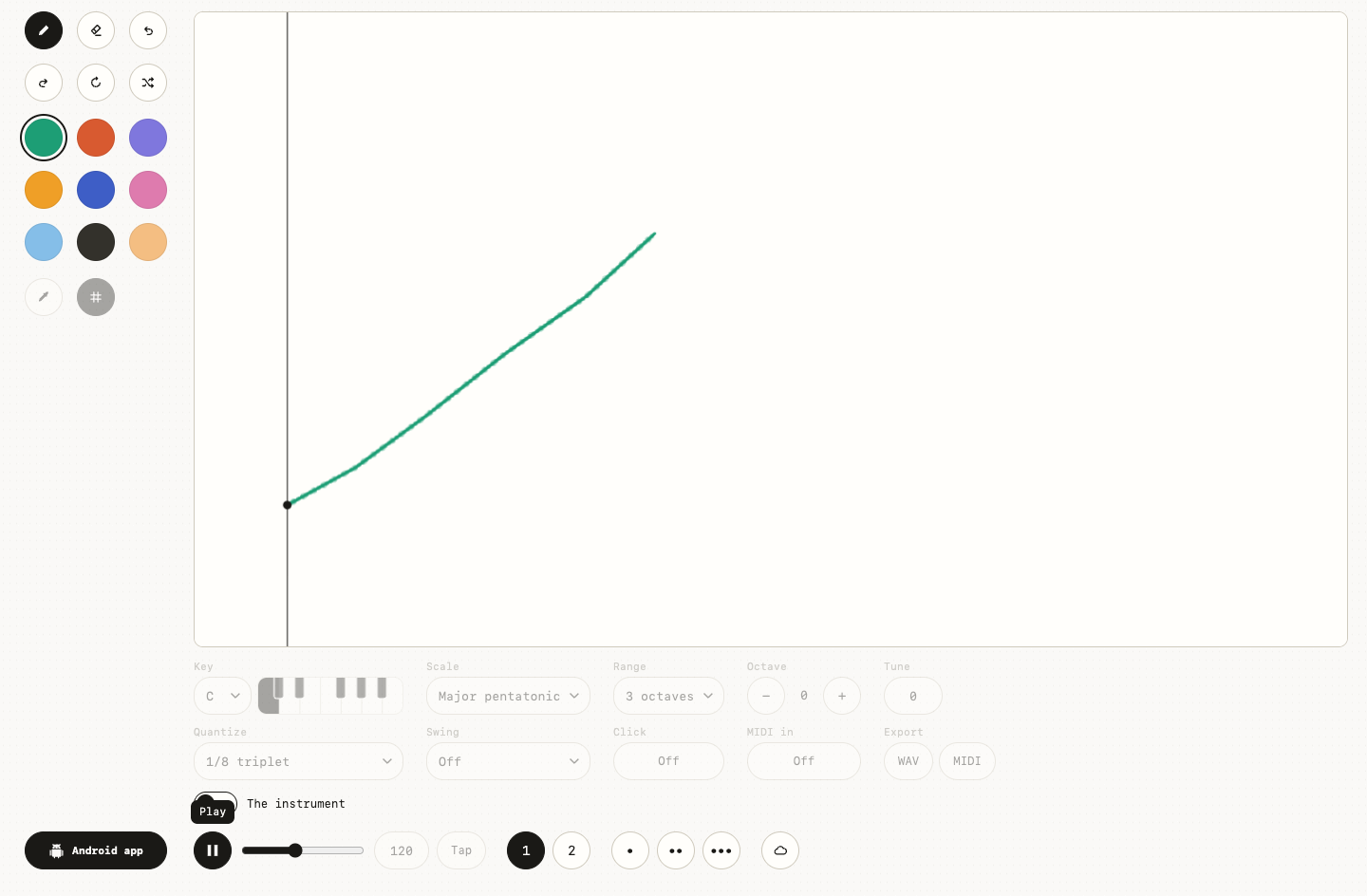
Pocket Rain is a study in density and silence. Short falling marks suggest droplets, but the game becomes musical when one part of the canvas is intentionally kept dry.
For the next pass: Scatter small descending strokes in two clusters and leave a wide dry gap between them. Move three droplets into the empty area without changing their heights.
A cluster feels like a burst because events arrive close together; the untouched area becomes a structural rest. Ask yourself: Does the loop still contain a convincing pause, or has the rain become continuous?
This gets muddy when you start filling every empty patch because the picture seems unfinished. If that happens, erase the center again and treat the blank area as an active part of the composition.
A good second take is simple: Use one color for high light rain and another for lower heavy drops. You should hear two weather-like textures divided by a silence you can see. If the second take surprises you, keep it. A useful test can become a song idea.
Prompt 3: Stepping Stones
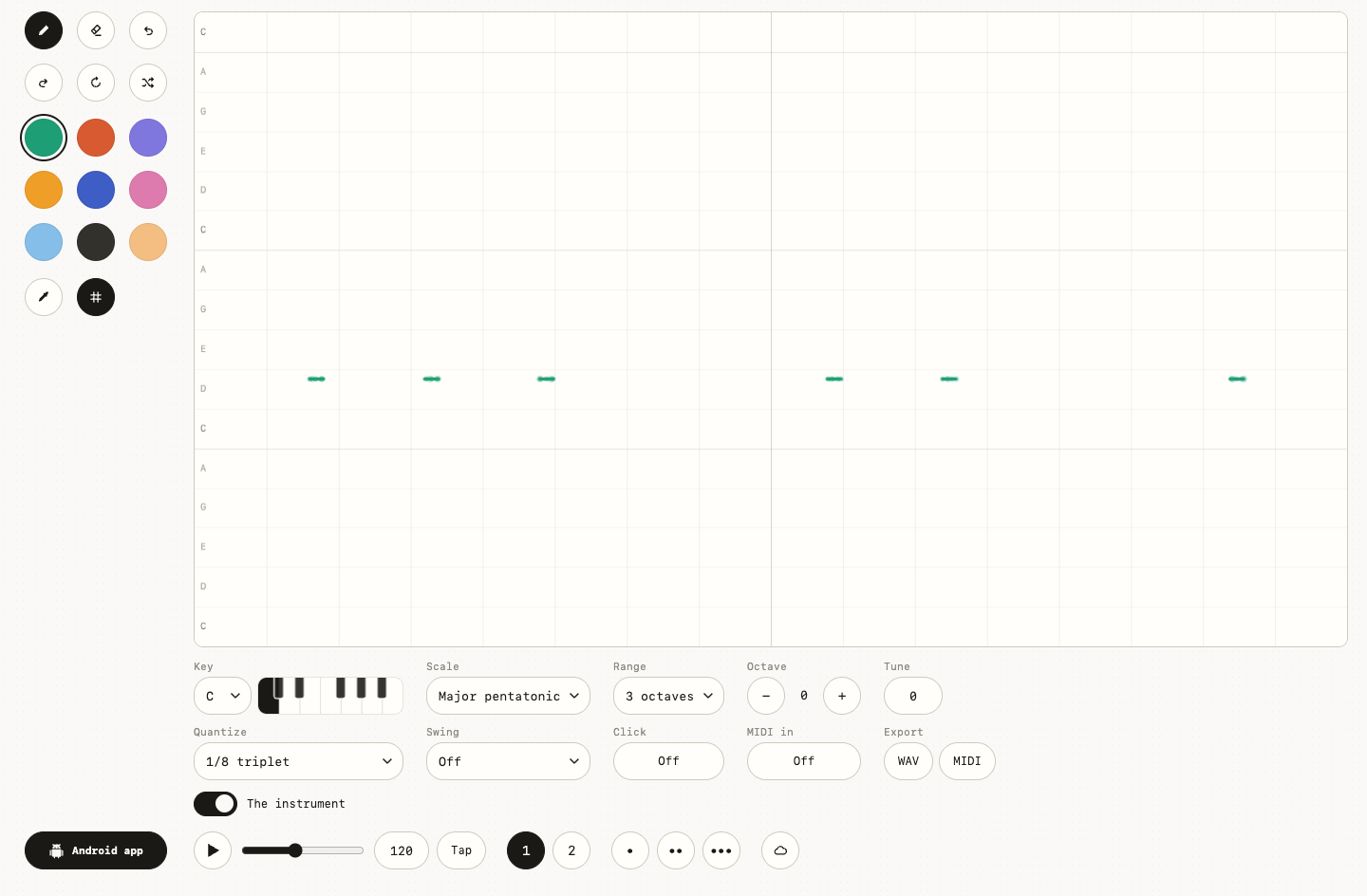
Stepping Stones turns separated dots into a path. The player predicts the next landing, so one surprising final stone can make a minimal drawing feel like a complete musical joke.
Start small: Place five evenly spaced dots that rise one step at a time, then put the sixth dot low on the page. Move the final low dot closer to the fifth without changing its height.
Repeated spacing creates expectation, while a pitch and timing deviation makes the last event function as a turn. Ask yourself: Does the drop feel more sudden when it arrives sooner?
Watch out for making every stone a different size, color, height, and distance. If that happens, rebuild the first five as a consistent pattern and reserve contrast for the ending.
If you are curious, try this: Add a second-color shadow slightly below every other stone. The path should remain easy to follow while the shadows create a slower counter-pattern. You may prefer the imperfect version. That is a choice, not a failed experiment.
Prompt 4: Sound Constellation
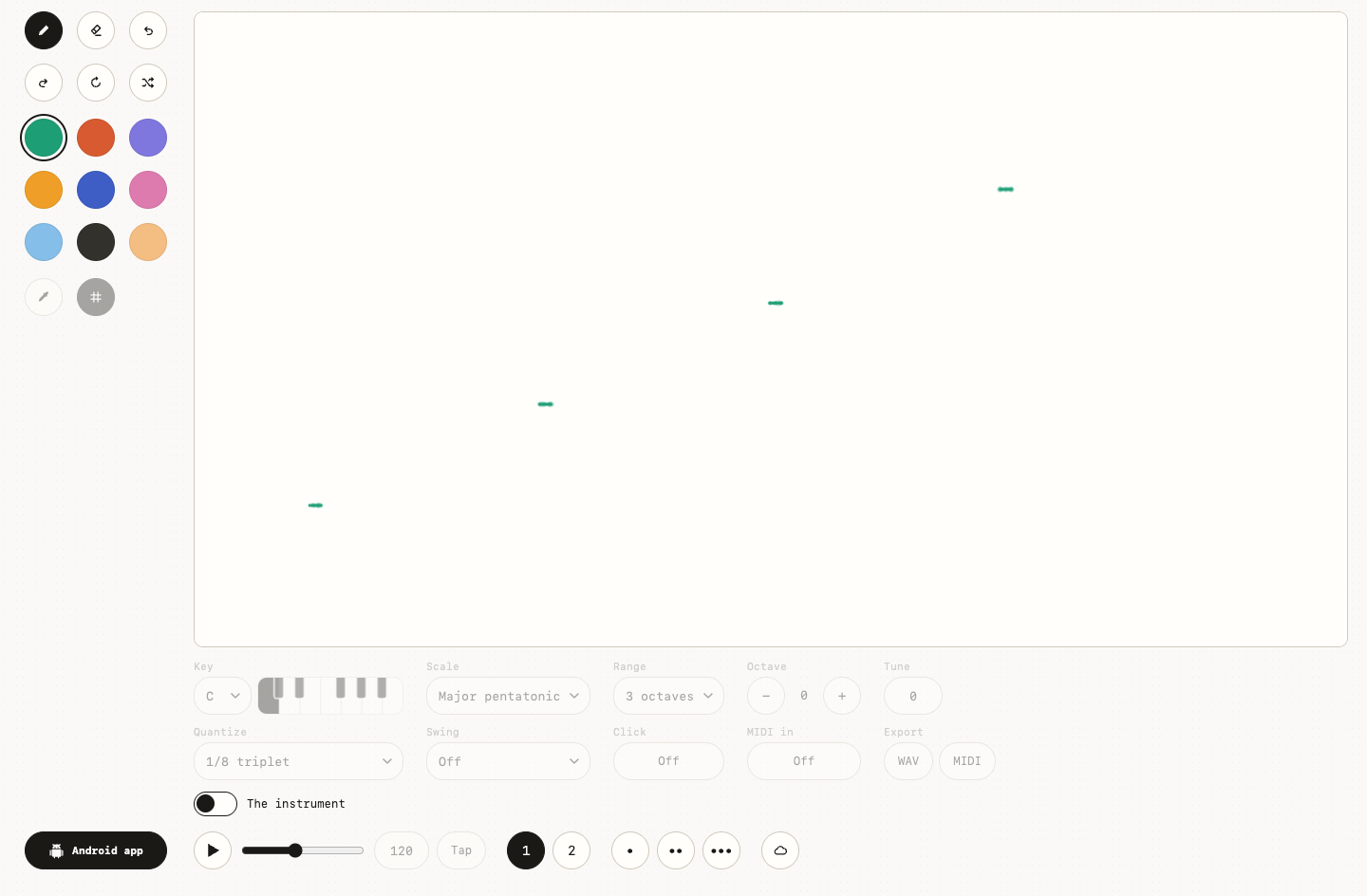
A constellation balances isolated points with a few meaningful connections. The music gains shape when you resist joining everything and let distant stars remain distinct events.
Here is the useful comparison: Place eight dots at varied heights, then connect only three neighboring pairs with short lines. Connect one distant pair across a wide horizontal span.
Connected marks encourage the ear to follow a contour, while isolated dots retain sharper individual entrances. Ask yourself: Does the long connection create continuity where separate stars previously felt spacious?
If the result is hard to read, you may be turning the constellation into a single tangled scribble. If that happens, undo the longest connections and keep only lines whose audible role you can identify.
There is one more version worth hearing: Assign warm and cool colors to two imaginary constellations that overlap in time. The finished loop should contain two readable groups rather than one undifferentiated texture. The point is not to win the comparison; it is to notice what changed.
Prompt 5: Ten-Second Scribble Relay
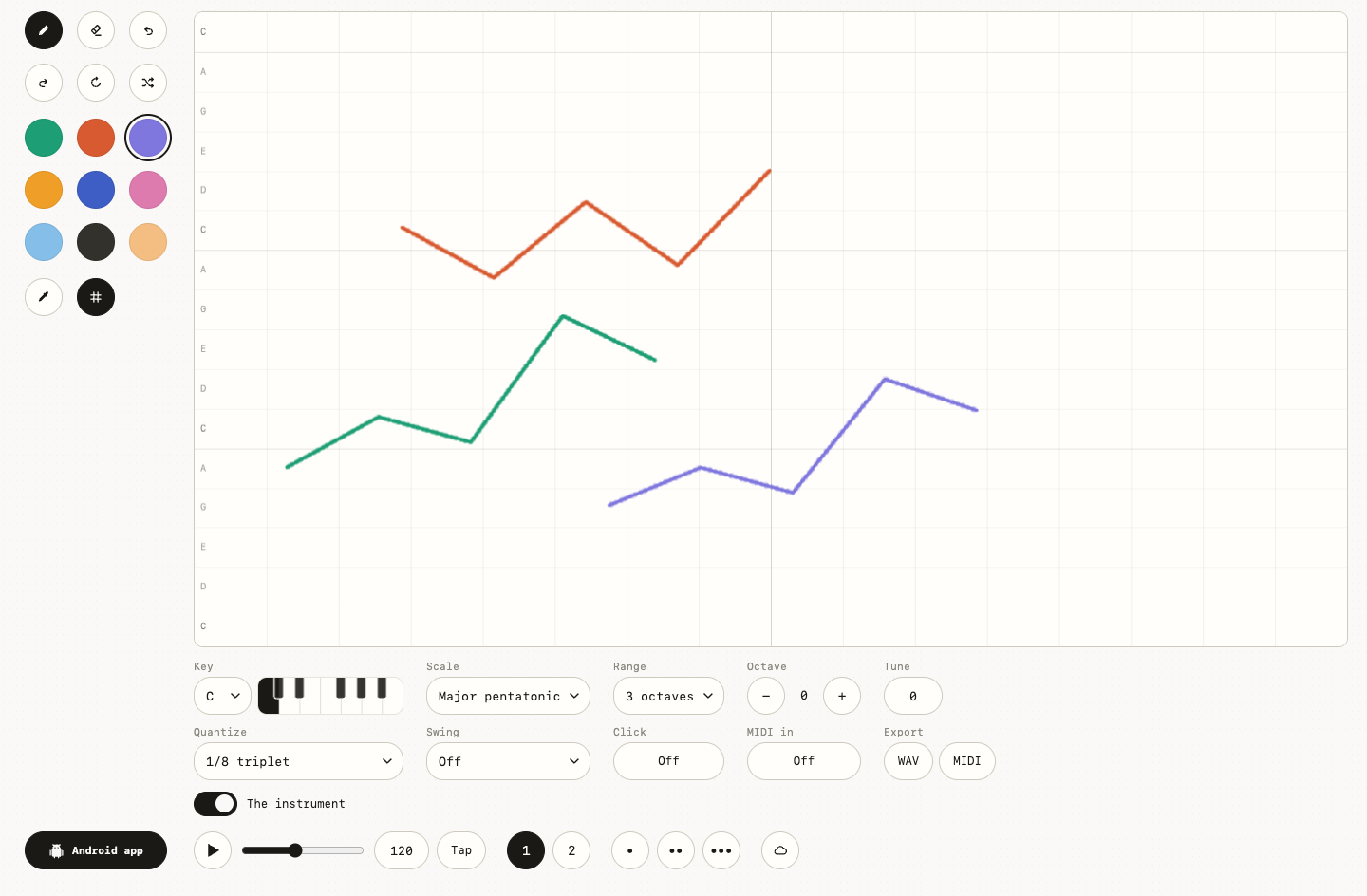
The relay replaces careful planning with a time limit. Its value is not random mess; it gives you raw material that can be edited after the uninterrupted gesture has revealed an unexpected rhythm or contour.
Before adding anything else: Draw one continuous line for ten seconds, stop immediately, and listen before correcting anything. Erase or undo one section that masks the clearest moment in the scribble.
Fast drawing produces accidental repetition and contrast that deliberate editing can turn into a stronger phrase. Ask yourself: Which fragment remains memorable after the densest overlap is removed?
The comparison stops being useful when you start treating the first take as sacred even when every section competes for attention. If that happens, identify one contour worth keeping, clear the page, and redraw only that fragment with more space.
You can turn the test into a sketch: Pass the canvas to another player, who adds one color for ten seconds. The relay should sound collaborative while each color remains visually attributable to a turn. Save the odd result if it makes you want to listen again.
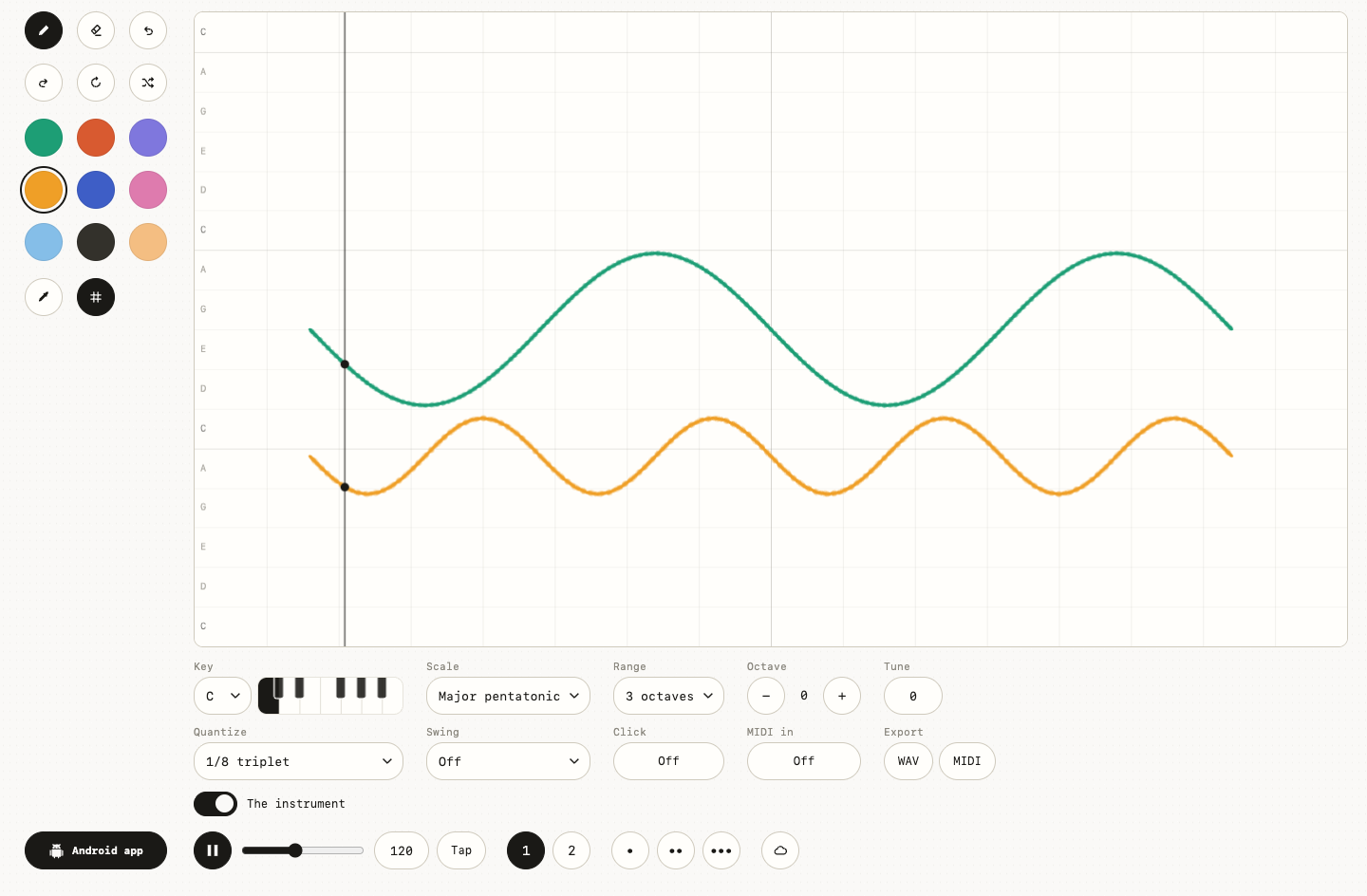
Prompt 6: Pulse Garden
Pulse Garden uses repeated stems as a stable ground and places slower melodic details above them. It is a friendly introduction to layering because the picture clearly separates support from decoration.
For the last pass: Draw eight short stems at even intervals, then add a colored dot above every second stem. Raise only the last two dots and leave all stems unchanged.
One layer can repeat a pulse while another moves at a slower rate and supplies melodic direction. Ask yourself: Does the support stay steady while the upper layer develops an ending?
The last thing to avoid is placing decorative dots at every available position until they duplicate the stems. If that happens, remove half the upper marks and listen for the slower relationship again.
Then stop reading and try one final variation: Switch on a beat pattern, then decide whether it supports or overwhelms the drawn stems. The best version should retain a visible garden-like pattern and an audible hierarchy between layers. You have enough information now. Close the guide and make the next choice by ear.
Wiggly Music app
Keep making music on Android.
Take the idea with you in Wiggly Music.